Using an old Wireless Router as an Access Point or Range Extender.
Surprisingly easy to do, if you know how.
http://www.makeuseof.com/tag/how-to-turn-an-old-router-into-a-wireless-bridge/
http://www.dslreports.com/faq/11233
See also:
http://www.dd-wrt.com/wiki/index.php/Wireless_Access_Point
Sunday, November 01, 2009


Thursday, August 14, 2008
Interesting and mostly (I think) right on the money article about why people pirate games.
Talking to Pirates
A couple of things that I found interesting were the implied percentages of people who responded with different reasons/justifications for their piracy. As someone who used to travel to Malaysia, Thailand, and Hong Kong regularly (before the Internet made location irrelevant) I saw just how many people would buy pirated movies/games just because they were cheap and easy. It was actually easier to get a pirated copy of Fallout 2 than it was to get a real one, by several orders of magnitude (as measured by distance to travel) and certainly cheaper...
I wasn't as surprised as Cliff that price was a major factor, although I think he was biased because he intended it as a question about his own games, not the general market, and the answers were based on retail for the most part, I would guess.
I was surprised that Cliff didn't mention Stardock as another example of a company that makes great games and doesn't use any DRM. I love their model of install it, use it on as many machines as you like, but you have to register to get the updates.
dropping the price of his own games I have to question, as well, since are already fairly reasonable, but certainly dropping the price of an old game right before the next installment/version comes out is an old marketing trick that is a proven one.
Best of luck to Cliff and all the other independent developers out there, it's a tough biz to be in.
Talking to Pirates
A couple of things that I found interesting were the implied percentages of people who responded with different reasons/justifications for their piracy. As someone who used to travel to Malaysia, Thailand, and Hong Kong regularly (before the Internet made location irrelevant) I saw just how many people would buy pirated movies/games just because they were cheap and easy. It was actually easier to get a pirated copy of Fallout 2 than it was to get a real one, by several orders of magnitude (as measured by distance to travel) and certainly cheaper...
I wasn't as surprised as Cliff that price was a major factor, although I think he was biased because he intended it as a question about his own games, not the general market, and the answers were based on retail for the most part, I would guess.
I was surprised that Cliff didn't mention Stardock as another example of a company that makes great games and doesn't use any DRM. I love their model of install it, use it on as many machines as you like, but you have to register to get the updates.
dropping the price of his own games I have to question, as well, since are already fairly reasonable, but certainly dropping the price of an old game right before the next installment/version comes out is an old marketing trick that is a proven one.
Best of luck to Cliff and all the other independent developers out there, it's a tough biz to be in.
Friday, March 07, 2008
xkcd is a fabulous comic for geeks, but today, a tribute...
xkcd - A webcomic of romance, sarcasm, math, and language - By Randall Munroe:

R.I.P. friend I never met...
xkcd - A webcomic of romance, sarcasm, math, and language - By Randall Munroe:
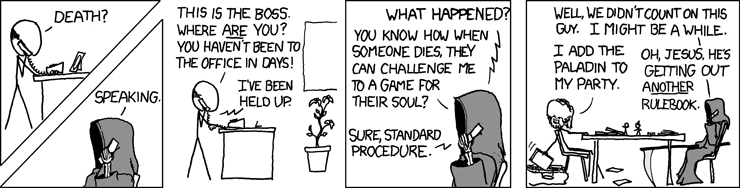
R.I.P. friend I never met...
Thursday, March 06, 2008
Why I hate Outlook, reason 76364939928
There is an issue where if you close Outlook via the Red X in the corner, it doesn’t close the same way as doing so via File/Close. This affects all versions of Outlook, btw. The X was hanging and leaving the exe process running as a background task, which, if you disconnect the computer, (laptop) causes issues.
Solution: disable the iTunes Add-in or any other Add-in that is unneeded.
At least it seems to be working…
Monday, December 31, 2007
so, by this point someone (if there is anyone out there) may have realized that what I really use this for at this point is to make a log of the answers to problems I have had to search for the answers to. This post is no exception.
problem: Sony vl900 remote transmits the on/off signal to my yamaha receiver too long and turns it back on when I try to turn it off.
Answer:
http://www.remotecentral.com/cgi-bin/mboard/rc-sony/thread.cgi?keywords=1387&highlight=repeat|vl900|rate
Another issue:
Problem: the Learning remote won't learn the TIVO Channel Down command
Answer: the TIVO remote doesn't transmit clearly - you have to buy another pre-programmed remote and use it to learn from
http://www.remotecentral.com/cgi-bin/mboard/rc-sony/thread.cgi?keywords=5137&highlight=button|vl900|tivo|down
problem: Sony vl900 remote transmits the on/off signal to my yamaha receiver too long and turns it back on when I try to turn it off.
Answer:
http://www.remotecentral.com/cgi-bin/mboard/rc-sony/thread.cgi?keywords=1387&highlight=repeat|vl900|rate
Another issue:
Problem: the Learning remote won't learn the TIVO Channel Down command
Answer: the TIVO remote doesn't transmit clearly - you have to buy another pre-programmed remote and use it to learn from
http://www.remotecentral.com/cgi-bin/mboard/rc-sony/thread.cgi?keywords=5137&highlight=button|vl900|tivo|down
Tuesday, November 20, 2007
One Laptop per Child Foundation, Invest your money and your time - OLPC Foundation
One Laptop per Child Foundation, Invest your money and your time - OLPC Foundation
I've been following this since it's inception and really believe in it's mission and potential.
I've been following this since it's inception and really believe in it's mission and potential.
Perhaps you know people who would want to participate?
(From photographer David Reicks)
Here's a Win-Win-Win for the Holidays.
A child in a developing country gets a laptop, you get one too, plus
you get a charitable donation and a nice freebie for when you travel.
I don't know about you, but I'd been eyeing the XO laptop since I
heard about it earlier this year. When I found the reminder email
from the One Laptop Per Child foundation in my "junk box" this
morning, I decided to take the plunge after seeing the sweetened deal.
The One Laptop Per Child education project has a "Give One, Get One"
program running from November 12 to the 26th. You pay $399 plus
shipping, and one of the XO laptops will be sent to a child in
developing country, and one of them is yours to keep (along with a
$200 charitable contribution).
The clincher was seeing that T-mobile sweetened the deal by offering
a free year of T-Mobile Hotspot internet access to people that
contribute (not just for the XO laptop, but any wireless device).
Since I'll be logging a few miles this next year for the SAA photo
metadata project, I think this makes it a Win-Win-Win! (if that's
possible). The cost of a year of Hotspot access is nearly the same as
what you are spending for the whole deal, so hard to see how you can go wrong.
Anyway, if you are interested, here's the link.
If you aren't interested in keeping your personal laptop, think of it as a
stock photo prop, or give it to one of your kids, a niece or nephew,
or other deserving child you know.
Tuesday, November 13, 2007
Here My Home Once Stood - A Holocaust Memoir
Here My Home Once Stood - A Holocaust Memoir
I got a letter last week from a good friend, Phil Shpilberg and, in an effort to help promote this amazing story and labor of love, I post this.
Dear Friends and Family,
In a week, my grandfather, Moyshe Rekhtman, will turn 80 years old. This coincides with the completion of my manuscript of his memoir, Here My Home Once Stood. For the past three years, I have passionately translated his Russian audio recordings, written and edited the story of his escape from two concentration camps and subsequent struggle to survive. As an almost blind 14-year-old, my grandfather refused to die in Nazi-occupied Ukraine, where 1.5 million other Jews perished.
I hope to publish this work soon. Until that time I would like to share excerpts of it with you via my blog
http://hmhos.blogspot.com/
If it moves you, please subscribe to the blog and tell others who may be interested. And of course, if you can help me connect with a publisher or agent, I would be grateful.
I hope that Here My Home Once Stood can, in some small way, stop future human suffering. Any proceeds from the project will go to that end.
Thank you,
Phil Shpilberg
I got a letter last week from a good friend, Phil Shpilberg and, in an effort to help promote this amazing story and labor of love, I post this.
Dear Friends and Family,
In a week, my grandfather, Moyshe Rekhtman, will turn 80 years old. This coincides with the completion of my manuscript of his memoir, Here My Home Once Stood. For the past three years, I have passionately translated his Russian audio recordings, written and edited the story of his escape from two concentration camps and subsequent struggle to survive. As an almost blind 14-year-old, my grandfather refused to die in Nazi-occupied Ukraine, where 1.5 million other Jews perished.
I hope to publish this work soon. Until that time I would like to share excerpts of it with you via my blog
http://hmhos.blogspot.com/
If it moves you, please subscribe to the blog and tell others who may be interested. And of course, if you can help me connect with a publisher or agent, I would be grateful.
I hope that Here My Home Once Stood can, in some small way, stop future human suffering. Any proceeds from the project will go to that end.
Thank you,
Phil Shpilberg
Wednesday, August 15, 2007
GameDaily BIZ: Study: Want to Make a Friend for Life? Play an MMORPG
My Wife and I have started playing WoW together. It's the first time that she's every really played a computer game and it's been a lot of fun seeing the game through totally unjaded eyes. I get to see her frustrations and small triumphs of learning and understanding the game mechanics and UI and we are having a good time, too.
The reason we started now is that I'm required to play WoW by my new job - Production Director at ZeniMax Online Studios. I've avoided it (although I've played lots of other MMOs over the years) because, with a one year old, a high stress job (the old one), and a house that needs constant attention, I figured I just didn't have the time, and I knew I'd enjoy it. Turns out, I do. I'm having trouble not playing lots while she isn't around.
We've had several topics come up because of the shared experience.
- the appropriateness of children playing in an environment where they can 'talk to strangers'
- the need to make the interface easier to use (especially movement controls)
- online relationships - why and how
- TV vs. Games
- Outside vs. Inside play
- Reading vs. Games as a learning tool
Most of the conversations have ended with either "Everything in Moderation" or "yeah, that's a potential problem, we'll have to consider that" (either something to consider as parents or something that my company needs to work on in order to make it more 'friendly' to new users)
More later on details, but it's been fascinating, in any case.
My Wife and I have started playing WoW together. It's the first time that she's every really played a computer game and it's been a lot of fun seeing the game through totally unjaded eyes. I get to see her frustrations and small triumphs of learning and understanding the game mechanics and UI and we are having a good time, too.
The reason we started now is that I'm required to play WoW by my new job - Production Director at ZeniMax Online Studios. I've avoided it (although I've played lots of other MMOs over the years) because, with a one year old, a high stress job (the old one), and a house that needs constant attention, I figured I just didn't have the time, and I knew I'd enjoy it. Turns out, I do. I'm having trouble not playing lots while she isn't around.
We've had several topics come up because of the shared experience.
- the appropriateness of children playing in an environment where they can 'talk to strangers'
- the need to make the interface easier to use (especially movement controls)
- online relationships - why and how
- TV vs. Games
- Outside vs. Inside play
- Reading vs. Games as a learning tool
Most of the conversations have ended with either "Everything in Moderation" or "yeah, that's a potential problem, we'll have to consider that" (either something to consider as parents or something that my company needs to work on in order to make it more 'friendly' to new users)
More later on details, but it's been fascinating, in any case.
Monday, June 18, 2007
dasgift.com - The Music of Adrian James
Adrian's first solo release, seemingly stewed by taking the raw emotion of a goth band, the coherence of a classic Pink Floyd album, and the dark playfulness of early early Depeche Mode, overwhelms the senses as its name (German: The Poison) promises .
Excellent for the brooding dark times, or for blasting in the car, the subtle interweavings fusing in noisy environments and leaving you breathless in quiet ones.
Adrian's first solo release, seemingly stewed by taking the raw emotion of a goth band, the coherence of a classic Pink Floyd album, and the dark playfulness of early early Depeche Mode, overwhelms the senses as its name (German: The Poison) promises .
Excellent for the brooding dark times, or for blasting in the car, the subtle interweavings fusing in noisy environments and leaving you breathless in quiet ones.
Friday, April 27, 2007
BDC, Inc.
Warning! SCAM artists!
etrofield.com
BDC, Inc.
This site was started on 3/30/2007 and is claiming to sell Wii, PS3, and XBox360 consoles at below market cost. Yet another "if it looks too good to be true, it probably isn't" example.
Don't forget to use the 'report web forgery' link in Firefox to report bad sites!
etrofield.com
BDC, Inc.
This site was started on 3/30/2007 and is claiming to sell Wii, PS3, and XBox360 consoles at below market cost. Yet another "if it looks too good to be true, it probably isn't" example.
Don't forget to use the 'report web forgery' link in Firefox to report bad sites!
Wednesday, March 28, 2007
Kongregate: Play Understanding Games: Episode 3
An interesting little game that explains one way that games train people.
Kongregate: Play Understanding Games: Episode 3
In this case, the thing the game trains is fundamentally just how the game functions, but there is an underlying skill concerning pattern matching that is reinforced, along with some basic motor and computer skills that are required to complete the tasks. Almost all computer games require at least those basic skills to play, and many don't go any further, but some do. It's determining what and how to train the skills or knowledge that isn't inherent in the 'medium' that is the real challenge.
Kongregate: Play Understanding Games: Episode 3
In this case, the thing the game trains is fundamentally just how the game functions, but there is an underlying skill concerning pattern matching that is reinforced, along with some basic motor and computer skills that are required to complete the tasks. Almost all computer games require at least those basic skills to play, and many don't go any further, but some do. It's determining what and how to train the skills or knowledge that isn't inherent in the 'medium' that is the real challenge.
Thursday, February 15, 2007
The Wright Stuff - Popular Science
The Wright Stuff - Popular Science
Incredible interview with a really smart guy, Will Wright, creator of Sim City and The Sims:
Highlights:
How much is the game based on established scientific theory, Darwinian evolution or what have you, and how much of it is more seat-of-your-pants?
I think the rough arc of life in the game is a pretty accurate though caricatured representation of reality, in the way life evolved from single cell to multicell to intelligence. Specifically on every level that kind of depends on what you're looking at. The evolution part of the game, the player is actually designing the creature, so in fact it's almost like intelligent design rather than pure evolution for your creature. The creatures around you are in fact kind of evolving more naturally, but in fact behind them of course are intelligent designers making the specific versions. Once we get up to the civilization level it's kind of an abstraction of human history. What are the different ways in which humans have built larger and larger groupings of people? We've done it militarily, economically, culturally, those are represented in fairly abstract terms. Once we get to space the scope of the size of the galaxy is an interesting little model of the real galaxy in terms of the distance between stars, the type of other objects you have up there, planetary nebula, black holes, stuff like that are fairly accurately represented in terms of their distribution in the galaxy, the number of stars we're dealing with is actually a very small fraction. Even though we have millions of stars in our galaxy, it's a very small fraction of what a real galaxy has. But still from the player's point of view they're both still huge numbers – almost inconceivable. Unless there's a compelling reason to break reality we've tried to follow reality, but again, in a caricatured format.
Let's talk about the content sharing system, since that's one of the coolest things in the game. Can you explain how that works?
Every time the player makes something in the game – creature, building, vehicle, planet, whatever, it gets sent to our servers automatically, a compressed representation of it. As other players are playing the game we need to populate their game with other creatures around them in the evolution game, other cities around them in the civilization game, other planets and races and aliens in the space game, and those are actually coming from our server and were created by other players. so there's an infinite variety of NPCs that I can encounter in the game that are continually being made by the other players as they play. And whenever I encounter this content I actually end up building a little card deck in the game that we call Sporepedia, there's a little card to represent every piece of content, every creature, every building, every vehicle, and I can see who made that. I can see what its stats are. I can bookmark that person if I like their stuff and have their stuff… like I can find my best friend and say make sure my best friend's stuff comes into my game, so I encounter their worlds first. So it's almost what we were seeing people do with The Sims, where they would go browse web sites looking for cool stuff and then download it, except we kind of burn it all into the gameplay. I don't have to leave the game, put it in my folder, go browse the web – it's now part of the gameplay experience.
One of the oddball things about Spore, when you look at it, it's sort of a single-player massively multiplayer game, which seems at odds… I kind of like the idea that I won't be killed by a 14-year-old who has more skills than I do, but did you consider having it live online player versus player?
We thought about it. In fact, technically, based on all the stuff we've already done for it, it wouldn't be very hard at all. We've already solved all the hard problems we would need to do a persistent online world version of Spore. The hard part is, what happens when you come to a planet and the planet's offline? Which would be the case. In fact, one of the reasons why I kind of went down this path is that nobody has really explored the hybrid model. And this really is a hybrid, it's what we call a massively single-player game, where we try to get the benefits of an online game, which is all the people building the world collectively together, without the liabilities, which is that the 14-year-old can kill you or that you've invested all this time in your planet and somebody comes along and blows it up, and therefore you had to put everybody on the same level treadmill. And I hate these level treadmill games, and I wanted the players to feel really empowered. You know, you have this whole universe and this UFO and you really want to go out there and do epic things, but in an online game you couldn't. So trying to get the best of both worlds, figuring out what the sweet spot is between the features available through a shared universe experience and then the power available to a single-player experience. The intersection of those two things is kind of where Spore ended up and why it ended up there.
....
So the prospect of getting them to actually subscribe to a game for $10 a month was a very difficult business proposition to these people, who a lot of them don't even have credit cards. I mean I'm a hardcore gamer and I don't subscribe to any online games, and getting a casual player to do the same, it's totally different.
Incredible interview with a really smart guy, Will Wright, creator of Sim City and The Sims:
Highlights:
How much is the game based on established scientific theory, Darwinian evolution or what have you, and how much of it is more seat-of-your-pants?
I think the rough arc of life in the game is a pretty accurate though caricatured representation of reality, in the way life evolved from single cell to multicell to intelligence. Specifically on every level that kind of depends on what you're looking at. The evolution part of the game, the player is actually designing the creature, so in fact it's almost like intelligent design rather than pure evolution for your creature. The creatures around you are in fact kind of evolving more naturally, but in fact behind them of course are intelligent designers making the specific versions. Once we get up to the civilization level it's kind of an abstraction of human history. What are the different ways in which humans have built larger and larger groupings of people? We've done it militarily, economically, culturally, those are represented in fairly abstract terms. Once we get to space the scope of the size of the galaxy is an interesting little model of the real galaxy in terms of the distance between stars, the type of other objects you have up there, planetary nebula, black holes, stuff like that are fairly accurately represented in terms of their distribution in the galaxy, the number of stars we're dealing with is actually a very small fraction. Even though we have millions of stars in our galaxy, it's a very small fraction of what a real galaxy has. But still from the player's point of view they're both still huge numbers – almost inconceivable. Unless there's a compelling reason to break reality we've tried to follow reality, but again, in a caricatured format.
Let's talk about the content sharing system, since that's one of the coolest things in the game. Can you explain how that works?
Every time the player makes something in the game – creature, building, vehicle, planet, whatever, it gets sent to our servers automatically, a compressed representation of it. As other players are playing the game we need to populate their game with other creatures around them in the evolution game, other cities around them in the civilization game, other planets and races and aliens in the space game, and those are actually coming from our server and were created by other players. so there's an infinite variety of NPCs that I can encounter in the game that are continually being made by the other players as they play. And whenever I encounter this content I actually end up building a little card deck in the game that we call Sporepedia, there's a little card to represent every piece of content, every creature, every building, every vehicle, and I can see who made that. I can see what its stats are. I can bookmark that person if I like their stuff and have their stuff… like I can find my best friend and say make sure my best friend's stuff comes into my game, so I encounter their worlds first. So it's almost what we were seeing people do with The Sims, where they would go browse web sites looking for cool stuff and then download it, except we kind of burn it all into the gameplay. I don't have to leave the game, put it in my folder, go browse the web – it's now part of the gameplay experience.
One of the oddball things about Spore, when you look at it, it's sort of a single-player massively multiplayer game, which seems at odds… I kind of like the idea that I won't be killed by a 14-year-old who has more skills than I do, but did you consider having it live online player versus player?
We thought about it. In fact, technically, based on all the stuff we've already done for it, it wouldn't be very hard at all. We've already solved all the hard problems we would need to do a persistent online world version of Spore. The hard part is, what happens when you come to a planet and the planet's offline? Which would be the case. In fact, one of the reasons why I kind of went down this path is that nobody has really explored the hybrid model. And this really is a hybrid, it's what we call a massively single-player game, where we try to get the benefits of an online game, which is all the people building the world collectively together, without the liabilities, which is that the 14-year-old can kill you or that you've invested all this time in your planet and somebody comes along and blows it up, and therefore you had to put everybody on the same level treadmill. And I hate these level treadmill games, and I wanted the players to feel really empowered. You know, you have this whole universe and this UFO and you really want to go out there and do epic things, but in an online game you couldn't. So trying to get the best of both worlds, figuring out what the sweet spot is between the features available through a shared universe experience and then the power available to a single-player experience. The intersection of those two things is kind of where Spore ended up and why it ended up there.
....
So the prospect of getting them to actually subscribe to a game for $10 a month was a very difficult business proposition to these people, who a lot of them don't even have credit cards. I mean I'm a hardcore gamer and I don't subscribe to any online games, and getting a casual player to do the same, it's totally different.
I find I don't subscribe to World of Warcraft – I appreciate what they did, but I have maybe a half hour to play, an hour to play, on my own schedule. I can't join a guild and make commitments – I have enough trouble keeping commitments to my own family.
Oh I know - same here!
And it seems like gaming more and more is slotted in, as opposed to the kid playing obsessively.
I think it's more interstitial time now, where you have these little tiny blocks of time that you carve out that you want to play a game in. I mean, that's why I play Battlefield all the time, because I can sit down and play half an hour of Battlefield, it's really satisfying and I don't have to worry if I never play it again for another two months. I'm not paying anything, nobody's waiting for me, no commitments. I can have a nice half-hour satisfying experience.
....
Do you see Spore, or the rest of your games for that matter, as being educational?
I think in a deep way yeah – that's kind of why I do them. But not in a curriculum-based, 'I'm gong to teach you facts' kind of way. I think more in terms of deep lessons of things like problem-solving, or just creativity – creativity is a fundamental of education that's not really taught so much. But giving people tools… what it means to be human is to learn to use tools to basically expand your abilities. And I think computer games are in some sense a fundamental tool for our imagination. If we can let players create these elaborate worlds, there's a lot of thought, design thought, problem solving, expression that goes into what you're going to create. You know, I think of the world of hobbies, which isn't what it used to be. When I was a kid, you know, people that were into trains had a big train set and they spent a lot of time sculpting mountains and building villages, or they might have been into slot cars or dollhouses or whatever, but these hobbies involved skill, involved creativity, and at some point involved socialization. Finding other people and joining the model train club, comparing and contrasting our skills, our approaches. And I think a lot of computer gaming has kind of supplanted those activities, they have a lot of the aspects of hobbies. Especially the games that allow the player to be creative and to share that creativity and form a community around it. I think just in general, play is about problem-solving, about interacting with things in an unstructured way to get a sense of it and what the rules are.
Which is counter to current trends -- educational philosophy seems to have taken a huge step towards the three Rs, the basics, what you can regurgitate on a standardized test. And this seems to be going back to process-oriented education, where you're learning problem solving.
And a lot of it also is… you know, some of the most effective education is failure-based, where you're given a system and you can manipulate it and explore different failure states and success states, and all that. Most of our educational system is designed to protect you from failure. You know – here's how you write a proper sentence, here's how you do a math problem without failing. So basically, they don't let you experience failure. Failure is seen as a bad thing, not as a learning experience. And even when you get to the professional world, things like architecture, engineering, industrial design, they teach you how to do it the right way. Where it used to be you would build five bad buildings and they'd fall down and you'd learn yourself – that was more the apprenticeship, craftsmanship model. You'd build 20 bad chairs but eventually learn how to build a good one because you would learn the failure states yourself, inherently – you'd experience them directly. Whereas when you go to engineering school they teach you how not to fail, so you're never directly experiencing those failures. It limits your intuitions. Whereas a kid playing a game – the first thing they do is they'll sit there and play five or six times and learn from that, and they learn at a very core level in a very different way. They've actually explored the whole possibility space. It's not that they've been told 'don't go there because you'll fail' and so they never go there and never experience it directly on their own. They're encouraged to do that all on their own, in fact they're directly building that possibility map.
...
Where do you see gaming moving in the future?
One thing that really excites me, that we're doing just a little bit of in Spore… I described how the computer is kind of looking at what you do and what you buy, and developing this model of the player. I think that's going to be a fundamental differentiating factor between games and all other forms of media. The games can inherently observe you and build a more and more accurate model of the player on each individual machine, and then do a huge amount of things with that – actually customize the game, its difficulty, the content that it's pulling down, the goal structures, the stories that are being played out relative to every player. So in some sense you're teaching the game about yourself and it becomes kind of your ultimate playmate, in terms of knowing 'oh, I think you'd enjoy this' or 'try that,' and it's kind of playing against you. You and I might buy the same game off the shelf one day, play it for a month and, a month later, our games are almost unrecognizably different – because yours has evolved to fit and entertain you, and mine has evolved to fit and entertain me. And I think that's something that's going to be a fundamental thing about games about ten years from now, because we're just starting to see that more and more at this point.
....
Cooperative gaming is pretty rare at this point, which seems like shame. Because if I want to play with my kid, I don't necessarily want to be blowing his brains out.
And games are one of those funny things where it can be a very social experience relative to like sitting there watching television together, it's amazing. Just watching kids in front of their game consoles, how much intense socialization they go through. Playing Mario Kart or something, even when they're competing, it ends up being a bonding experience. And I think most people see first-person shooter multiplayer games as this very aggressive thing, but in fact if you look at the group of people playing kind of before and after, it feels much more like a bonding experience, they're having a shared experience, even though they're shooting each other in the game, it's really like they're playing cowboys and indians or tag or something. From their point of view it's not like they're hurting each other and having a fight, it's that they're sitting there playing this sport together, and they come away all having this shared experience.
...
Relevant how? Socially?
Socially, yeah. Getting people more connected to the real world through gaming. Because I think we all live in our own little bubbles, we have our own little lives and there's this whole world out there of things happening that we're kind of dimly aware of. We might pick up the paper or watch the news. And it's a complex world. A lot of very strange twisted dynamics, interesting things, very important things that are going to shape the future that our children live in. And that if you could just get everybody to be a little bit more aware of the world around them, and how it works, and have that feedback in to the course the world is taking, gaming could be an incredibly powerful mechanism for steering the system.
....
It would be interesting if all your virtual lives could intersect.
It's a simple idea of having cross-game compatible avatars – I've talked to quite a few people about that idea.
Thursday, December 28, 2006
Category: Very cool sites
meebo.com
I've been looking for a way to sign on to IM when I'm not at my own machine for the last couple of months, and the different IM providers seem to be hell-bent on making that as hard as possible. They want you to install their client on every machine in the world... (don't believe me? try searching for a web-enabled IM login from the site of one of the services.)
Meebo is the web equivalent of Trillain (but much lighter, of course)and allows you to sign on to multiple services at once.
Finally!
meebo.com
I've been looking for a way to sign on to IM when I'm not at my own machine for the last couple of months, and the different IM providers seem to be hell-bent on making that as hard as possible. They want you to install their client on every machine in the world... (don't believe me? try searching for a web-enabled IM login from the site of one of the services.)
Meebo is the web equivalent of Trillain (but much lighter, of course)and allows you to sign on to multiple services at once.
Finally!
Friday, August 11, 2006
Very cogent analysis of a messy subject. It's unfortunate that our own government seems incapable of "getting the joke."
gamesindustry.biz
Daily Update
10/08/2006
If you walk into a store in the United Kingdom to pick up a copy of Capcom's eagerly awaited Xbox 360 title Dead Rising, you'll find that the methods of dispatching zombies available to you in the game are somewhat, well, unadulterated. Smashing undead skulls into the floor and lopping heads off with well placed scythe slashes are only two of the many, many carnage related options which will be open to players of the game, which borrows many of its cues from classic zombie movies such as Dawn of the Dead.
The interesting thing about this level of violence and gore isn't that it's present in the first place - after all, zombie films and other horror and action movies have been blowing apart the undead in showers of claret for decades, and "decency" campaigners seem to have given up on moaning about escapist fantasy movies quite some time ago. No, what's interesting is that despite the game having a rocky time with censorship and ratings boards elsewhere in the world, in Britain it will be released entirely uncensored, with not a single change to the content.
That's a situation which movie aficionados have gradually become used to in this country; the British Board of Film Classification, empowered by the excellent if sometimes weakly enforced age rating system which is applied to media in the UK, has been passing more and more films without cuts. Instead, films are rated 18, and the board takes the view that if content is not clearly going to be harmful to adults, then adults should be permitted to view or experience it.
Now the BBFC is applying the same logic to videogames - and the straightforward, reasonable point of view expressed by the board brings a breath of fresh air to the debate over videogame violence and censorship, which has become increasingly bogged down in rhetoric and embarrassing public spats between key proponents on both sides in the last year or so.
You can read the board's full comments on why they're passing Dead Rising as an 18-rated game, uncut, in this news story - but suffice it to say that the guardians at the gates of Britain's sensitive minds not only regard claims that videogames turn people into killers with a sceptical eye, but they also, crucially, get the joke. Their statement to us not only acknowledges that the game is aimed at an adult audience (a fact commonly missed in discussions about violent videogames), but also that the violence has a fantasy element and crucially, that the game has "a sense of humour, albeit a macabre one."
Herein, perhaps, lies the clearest sign we've seen in quite some time that the tide is turning in favour of interactive media. The key problem faced by games for years has been that they are widely seen as being a form of entertainment which was aimed at children and which was both straightforward and unsubtle. When a newspaper talks about a film featuring a violent or sexual scene, readers automatically assume that this falls into the context of the film; when we talk about games featuring similar scenes, many people automatically assume that this game is an outright "violence simulator" or "sex simulator", because they cannot conceive of a game having complex narrative, satire, humour or subtlety.
In acknowledging the humour which drives Dead Rising, the BBFC acknowledges the maturity of the videogaming medium. In granting it an 18 rating - described by a spokesperson as "a fairly straightforward 18" - it acknowledges it as entertainment for adults. In making these viewpoints public, as much as in granting the rating in the first place, it shows us how far the perception of videogames in the British political establishment has come.
We welcome, of course, the opportunity to enjoy Dead Rising as its creators intended - an experience no more harmful, and possibly even more fun, than spending an evening with friends watching cult classic George A Romero films. More than that, however, we welcome the implicit confirmation of the BBFC's view that games deserve equal treatment to their counterparts in film. The censorship debate will roll on regardless, of course - especially in the USA where much of it focuses on the ability to ban the sale of violent games to minors, something which the UK has already done for years - but the end of this long dark tunnel is more clearly in sight than ever before.
gamesindustry.biz
Daily Update
10/08/2006
If you walk into a store in the United Kingdom to pick up a copy of Capcom's eagerly awaited Xbox 360 title Dead Rising, you'll find that the methods of dispatching zombies available to you in the game are somewhat, well, unadulterated. Smashing undead skulls into the floor and lopping heads off with well placed scythe slashes are only two of the many, many carnage related options which will be open to players of the game, which borrows many of its cues from classic zombie movies such as Dawn of the Dead.
The interesting thing about this level of violence and gore isn't that it's present in the first place - after all, zombie films and other horror and action movies have been blowing apart the undead in showers of claret for decades, and "decency" campaigners seem to have given up on moaning about escapist fantasy movies quite some time ago. No, what's interesting is that despite the game having a rocky time with censorship and ratings boards elsewhere in the world, in Britain it will be released entirely uncensored, with not a single change to the content.
That's a situation which movie aficionados have gradually become used to in this country; the British Board of Film Classification, empowered by the excellent if sometimes weakly enforced age rating system which is applied to media in the UK, has been passing more and more films without cuts. Instead, films are rated 18, and the board takes the view that if content is not clearly going to be harmful to adults, then adults should be permitted to view or experience it.
Now the BBFC is applying the same logic to videogames - and the straightforward, reasonable point of view expressed by the board brings a breath of fresh air to the debate over videogame violence and censorship, which has become increasingly bogged down in rhetoric and embarrassing public spats between key proponents on both sides in the last year or so.
You can read the board's full comments on why they're passing Dead Rising as an 18-rated game, uncut, in this news story - but suffice it to say that the guardians at the gates of Britain's sensitive minds not only regard claims that videogames turn people into killers with a sceptical eye, but they also, crucially, get the joke. Their statement to us not only acknowledges that the game is aimed at an adult audience (a fact commonly missed in discussions about violent videogames), but also that the violence has a fantasy element and crucially, that the game has "a sense of humour, albeit a macabre one."
Herein, perhaps, lies the clearest sign we've seen in quite some time that the tide is turning in favour of interactive media. The key problem faced by games for years has been that they are widely seen as being a form of entertainment which was aimed at children and which was both straightforward and unsubtle. When a newspaper talks about a film featuring a violent or sexual scene, readers automatically assume that this falls into the context of the film; when we talk about games featuring similar scenes, many people automatically assume that this game is an outright "violence simulator" or "sex simulator", because they cannot conceive of a game having complex narrative, satire, humour or subtlety.
In acknowledging the humour which drives Dead Rising, the BBFC acknowledges the maturity of the videogaming medium. In granting it an 18 rating - described by a spokesperson as "a fairly straightforward 18" - it acknowledges it as entertainment for adults. In making these viewpoints public, as much as in granting the rating in the first place, it shows us how far the perception of videogames in the British political establishment has come.
We welcome, of course, the opportunity to enjoy Dead Rising as its creators intended - an experience no more harmful, and possibly even more fun, than spending an evening with friends watching cult classic George A Romero films. More than that, however, we welcome the implicit confirmation of the BBFC's view that games deserve equal treatment to their counterparts in film. The censorship debate will roll on regardless, of course - especially in the USA where much of it focuses on the ability to ban the sale of violent games to minors, something which the UK has already done for years - but the end of this long dark tunnel is more clearly in sight than ever before.
Thursday, June 22, 2006
IRAQ INDEX
Tracking Reconstruction and Security
in Post-Saddam Iraq
The Iraq Index is a statistical compilation of economic, public opinion, and security data. This resource will provide updated information on various criteria, including crime, telephone and water service, troop fatalities, unemployment, Iraqi security forces, oil production, and coalition troop strength.
Iraq Index
Tracking Reconstruction and Security
in Post-Saddam Iraq
The Iraq Index is a statistical compilation of economic, public opinion, and security data. This resource will provide updated information on various criteria, including crime, telephone and water service, troop fatalities, unemployment, Iraqi security forces, oil production, and coalition troop strength.
Iraq Index
Tuesday, May 30, 2006
Tuesday, March 14, 2006
Thursday, February 09, 2006
Thursday, January 26, 2006
bit-tech.net | MPAA illegally copies movies:
MPAA illegally copies movies
Posted 10:41 - 25 January 2006 - by Wil Harris
Oh the irony. The MPAA is being forced to justify its actions today, after reports emerged that it has been engaging in unauthorised copying of movies.
The movie in question is called This movie has not yet been rated, and is a documentary featuring examining the actions and the structure of the MPAA. The MPAA itself is a collection of anonymous individuals who are solely responsible for the ratings of films in the USA, yet have little-to-no accountability. The documentary attempts to find out who these people are, and then examines the attitudes of the association to things such as sex v violence, heterosexual v homosexual content, the treatment of indie films v the preference allegedly given to big studios.
By way of justification, the MPAA said that the spying and intrusion on its employees warranted it distributing copies of the movie to its employees.
Here's a quote from the Ars story:
'Director Kirby Dick submitted the film for rating in November. After receiving the movie, the MPAA subsequently made copies without Dick's permission. Dick had specifically requested in an e-mail that the MPAA not make copies of the movie. The MPAA responded by saying that 'the confidentiality of your film is our first priority.'
Dick later learned that the MPAA made copies of the film to distribute them to its employees, despite the MPAA's stance on unauthorized copying.'
Hands up if you hate American monopolists? Yeah, us too. Over in the UK, we have the British Board of Film Classification, an open and identifiable body that has a reputation for being progressive and friendly with its ratings. Then again, it doesn't have to deal with the American schizophrenic attitude to sex, which must help.
What do you make of the MPAA's actions? Are they acting responsibily for the good of their members, or are they swiftly making themselves into a laughing stock? Answers on a postcard please, or alternatively, in our forum. "
MPAA illegally copies movies
Posted 10:41 - 25 January 2006 - by Wil Harris
Oh the irony. The MPAA is being forced to justify its actions today, after reports emerged that it has been engaging in unauthorised copying of movies.
The movie in question is called This movie has not yet been rated, and is a documentary featuring examining the actions and the structure of the MPAA. The MPAA itself is a collection of anonymous individuals who are solely responsible for the ratings of films in the USA, yet have little-to-no accountability. The documentary attempts to find out who these people are, and then examines the attitudes of the association to things such as sex v violence, heterosexual v homosexual content, the treatment of indie films v the preference allegedly given to big studios.
By way of justification, the MPAA said that the spying and intrusion on its employees warranted it distributing copies of the movie to its employees.
Here's a quote from the Ars story:
'Director Kirby Dick submitted the film for rating in November. After receiving the movie, the MPAA subsequently made copies without Dick's permission. Dick had specifically requested in an e-mail that the MPAA not make copies of the movie. The MPAA responded by saying that 'the confidentiality of your film is our first priority.'
Dick later learned that the MPAA made copies of the film to distribute them to its employees, despite the MPAA's stance on unauthorized copying.'
Hands up if you hate American monopolists? Yeah, us too. Over in the UK, we have the British Board of Film Classification, an open and identifiable body that has a reputation for being progressive and friendly with its ratings. Then again, it doesn't have to deal with the American schizophrenic attitude to sex, which must help.
What do you make of the MPAA's actions? Are they acting responsibily for the good of their members, or are they swiftly making themselves into a laughing stock? Answers on a postcard please, or alternatively, in our forum. "
Wednesday, January 04, 2006
I've had a problem ever since I started using my work computer with some of my programs trying to load two copies at startup. It became obvious because I use Trillian and it will actually load twice, unlike most others that just ignored the second attempt to load. I found the solution in the Trillian Forums:
Trillian Discussion Forums - Trillian starts twice. Two icons in tray.:
timstyles
Junior Member
"I've found out why Windows runs everything in my startup menu twice. I had previously deleted the Startup folder in my user directory (C:\Documents and Settings\\Start Menu\Programs\Startup) and put program shortcuts in the common directory (C:\Documents and Settings\All Users\Start Menu\Programs\Startup).
There are two pairs of keys in the registry which point to these two folders. When one folder is deleted, the keys which pointed to it are modified to point to the remaining folder. The result is that both pairs of keys point to the same folder and things in it get started twice.
[...]
Note - you have to recreate the folder C:\Documents and Settings\\Start Menu\Programs\Startup if you deleted it, or the key will just change back.
hammo1j
Junior Member
[...]
People should go to:
HKEY_CURRENT_USER\Software\Microsoft\Windows\CurrentVersion\Explorer\User Shell Folders
And change the %ALLUSERSPROFILE% to
%USERPROFILE% on the entries which will obviously have been modified from this setting.
If you reboot the machine the changes will be automatically propagated to the other directory.
ME:
Thanks to both for the instructions!
Trillian Discussion Forums - Trillian starts twice. Two icons in tray.:
timstyles
Junior Member
"I've found out why Windows runs everything in my startup menu twice. I had previously deleted the Startup folder in my user directory (C:\Documents and Settings\
There are two pairs of keys in the registry which point to these two folders. When one folder is deleted, the keys which pointed to it are modified to point to the remaining folder. The result is that both pairs of keys point to the same folder and things in it get started twice.
[...]
Note - you have to recreate the folder C:\Documents and Settings\
Junior Member
People should go to:
HKEY_CURRENT_USER\Software\Microsoft\Windows\CurrentVersion\Explorer\User Shell Folders
And change the %ALLUSERSPROFILE% to
%USERPROFILE% on the entries which will obviously have been modified from this setting.
If you reboot the machine the changes will be automatically propagated to the other directory.
ME:
Thanks to both for the instructions!
Subscribe to:
Posts (Atom)